
When mobility starts to decline, even the simplest tasks like rising from a chair or moving from a bed to a wheelchair can become overwhelming challenges. For caregivers and family members, assisting with these transfers often leads to back strain, fatigue, and an increased risk of injury. The solution lies in a piece of equipment that bridges the gap between total dependence and full mobility: a sit to stand lift for home use. Unlike full-body sling lifts, these devices are specifically designed for individuals who have some weight-bearing ability and upper body strength. They provide a gentle, controlled lift that assists the user from a seated to a standing position, making daily living safer and more dignified. This article explores everything you need to know about selecting, using, and benefiting from these invaluable aids in a residential setting.
Understanding How a Sit to Stand Lift Works in a Home Environment
Before investing in any assistive technology, it is critical to understand the mechanics and purpose of a sit to stand lift. The fundamental design is elegant yet practical. The device consists of a stable base with wheels, a vertical mast, a battery-operated or manual lifting mechanism, and a special sling or vest that the user wears. The user positions themselves on the edge of a bed, chair, or toilet. The lift is then rolled close until the base slides under the piece of furniture. The user attaches the sling around their back and under their arms, and the lift gently raises them to a near-standing position. The key difference between this and a standard patient lift is the active participation of the user. The individual is expected to help bear weight through their legs and use the lift as a supportive guide.
For home use, this design offers multiple advantages. First, it protects the caregiver from the repeated bending and twisting motions that cause musculoskeletal disorders. Second, it preserves the dignity of the user by allowing them to contribute to their own transfer. Many people feel humiliated when they are fully lifted like a log; sit to stand lifts allow them to stand with assistance, promoting circulation, bone density, and muscle strength. Third, the compact footprint of most home models means they fit through standard doorways and can be stored in a closet when not in use. Modern units feature padded knee pads that brace the user’s knees, preventing sliding and providing a stable pivot point. The control pendant is typically simple, with up, down, and emergency stop functions, making it user-friendly even for seniors who are not technically inclined. Importantly, the transfer process reduces the risk of falls, which are the leading cause of injury among older adults living at home.
When evaluating a sit to stand lift for home use, consider the weight capacity and battery life. Most home lifts accommodate users up to 350 to 450 pounds, though heavier-duty models exist. Battery-powered lifts are preferable because they eliminate the tripping hazard of cords and allow for transfers in any room, including bathrooms. Always ensure the lift’s sling is properly sized—a poorly fitted sling can cause discomfort or instability. Many models also offer split-leg bases, which provide a more open space for the user to stand, making it easier to approach a toilet or chair. In real-world home settings, these lifts are invaluable for morning routines, transferring from the bed to a wheelchair, and especially for toileting, which is often the most physically demanding and psychologically difficult task for both caregiver and patient.
Key Features to Look for When Choosing a Lift for Residential Care
Not all sit to stand lifts are created equal, especially when the environment shifts from a hospital to a private residence. In a home, space is often limited, and aesthetics matter. A bulky, industrial-looking lift may feel intrusive in a living room or bedroom. Therefore, one of the first considerations is the portability and maneuverability of the device. Look for models with large, locking casters that roll smoothly over hardwood floors, tile, and low-pile carpets. Swivel casters at both ends allow for tight turns in narrow hallways or small bathrooms. The base should be wide enough to provide stability but narrow enough to fit under most standard chairs and beds. Many home users prefer lifts that can be disassembled without tools for travel or storage, making them versatile for use in multiple rooms or even during visits to family.
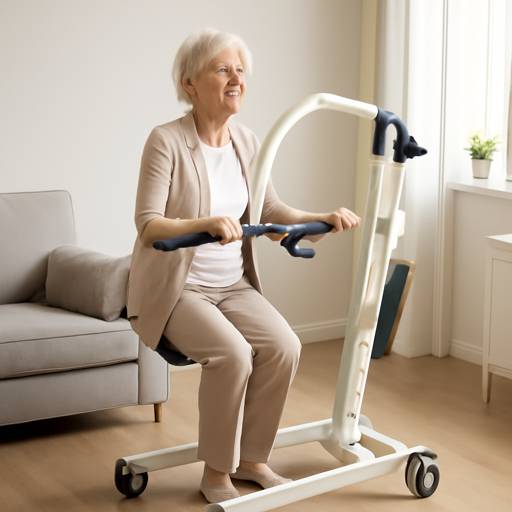
Another critical feature is the lifting mechanism itself. Manual hydraulic lifts are cheaper but require significant physical effort to pump, which can be exhausting for a caregiver during multiple daily transfers. Electric lifts with rechargeable batteries are the gold standard for home use. They provide smooth, quiet operation, which is important when the user is sleeping or resting. Also, pay attention to the lift’s “spread” range—the distance the base can open. Some bases have a fixed width, while others are adjustable. An adjustable base is superior for home use because it can be narrowed to pass through doorways and widened during use to enhance stability. Safety features such as an emergency manual lowering function (in case of power failure) and a full-charge indicator are non-negotiable. The sling attachment system should also be examined. Quick-release clips or loops that are color-coded for left and right sides simplify the setup process for caregivers who may be fatigued or distracted.
A real-world case study illustrates these points. Consider the situation of Margaret, a 78-year-old woman recovering from hip replacement surgery. She lived alone in a two-story house but spent most of her time on the first floor. Her daughter purchased a home sit to stand lift with a split-leg base and a padded knee rest. The lift allowed Margaret to transfer independently from her recliner to her toilet, with her daughter standing by for supervision only. The result was a significant drop in fall incidents and a dramatic improvement in Margaret’s emotional well-being, as she no longer felt completely reliant on her daughter for every movement. Within three weeks, her leg strength improved enough that she could stand without the lift for short periods, but she continued to use it for safety during bathroom transfers. This example underscores a vital point: a sit to stand lift is not a permanent crutch but a rehabilitation tool that can aid in recovery and prevent secondary complications like pneumonia or pressure sores that arise from prolonged immobility.
Real-World Applications and Case Studies: Transforming Daily Routines
Beyond the technical specifications, the true value of a sit to stand lift for home use is demonstrated in the daily lives of users and their caregivers. One common scenario involves post-operative care, specifically after knee or hip replacement surgery. Patients are often instructed to bear weight as tolerated, but the pain and instability make standing up from a low chair or toilet nearly impossible. A sit to stand lift provides the gradual, supported movement required to get upright without sudden, painful jolts. In a documented case from a home health agency, an 85-year-old man with severe arthritis in both knees was able to remain in his own home for an additional two years after acquiring a lift. Previously, his daughter had to call an ambulance whenever he fell, which happened weekly. With the lift, he could stand safely, and his daughter’s caregiver strain was reduced to a manageable level.
Another important application is in neurological conditions such as Parkinson’s disease or multiple sclerosis. These conditions often cause rigidity or balance issues that make standing from a seated position hazardous. A sit to stand lift does more than physically elevate the person; it provides a psychological safety net. Knowing that the lift will catch them if they stumble allows users to attempt standing more frequently, which in turn maintains their existing muscle function and delays the progression of weakness. In a group home setting, caregivers reported that using a lift for transfers eliminated almost all manual lifting injuries within six months. The staff turnover rate decreased because workers no longer suffered chronic back pain. While the article focuses on home use, the same principles apply: preventing caregiver injury is just as important as patient safety.
Finally, consider the toilet transfer, which is often the most hazardous activity in a home. The combination of slippery bathroom floors, tight spaces, and the need to lower onto a seat creates a perfect storm for falls. A sit to stand lift with a bathroom-compatible sling can be used to lower the user directly onto the toilet and then lift them off again. This eliminates the need for the caregiver to bend over and hold the user under the arms. Many home users report that this single application restores their sense of privacy and control. They no longer need to use a bedpan or commode chair in the living room. Instead, they can maintain a normal bathroom routine with minimal assistance. These real-world examples highlight that a sit to stand lift is not merely a piece of medical equipment—it is a tool for preserving autonomy, reducing risk, and improving quality of life for everyone in the household.
